
Amidst the bustling pace and modern breath of Ho Chi Minh City Open University – an environment flowing with continuous knowledge and integration – there exist profound moments of silence where thousand-year-old heritage finds resonance in the souls of the youth. The story of the Đông Sơn Bronze Drum – a sacred national treasure of Vietnam – has become an invisible bond between Duy Bình – a Vietnamese student in Southeast Asian Studies major and Lint – a Myanmar student. This cross-border friendship has breathed life into traditional values, bringing Vietnam’s millennium of civilization to the heart and sincere admiration of a friend from afar.
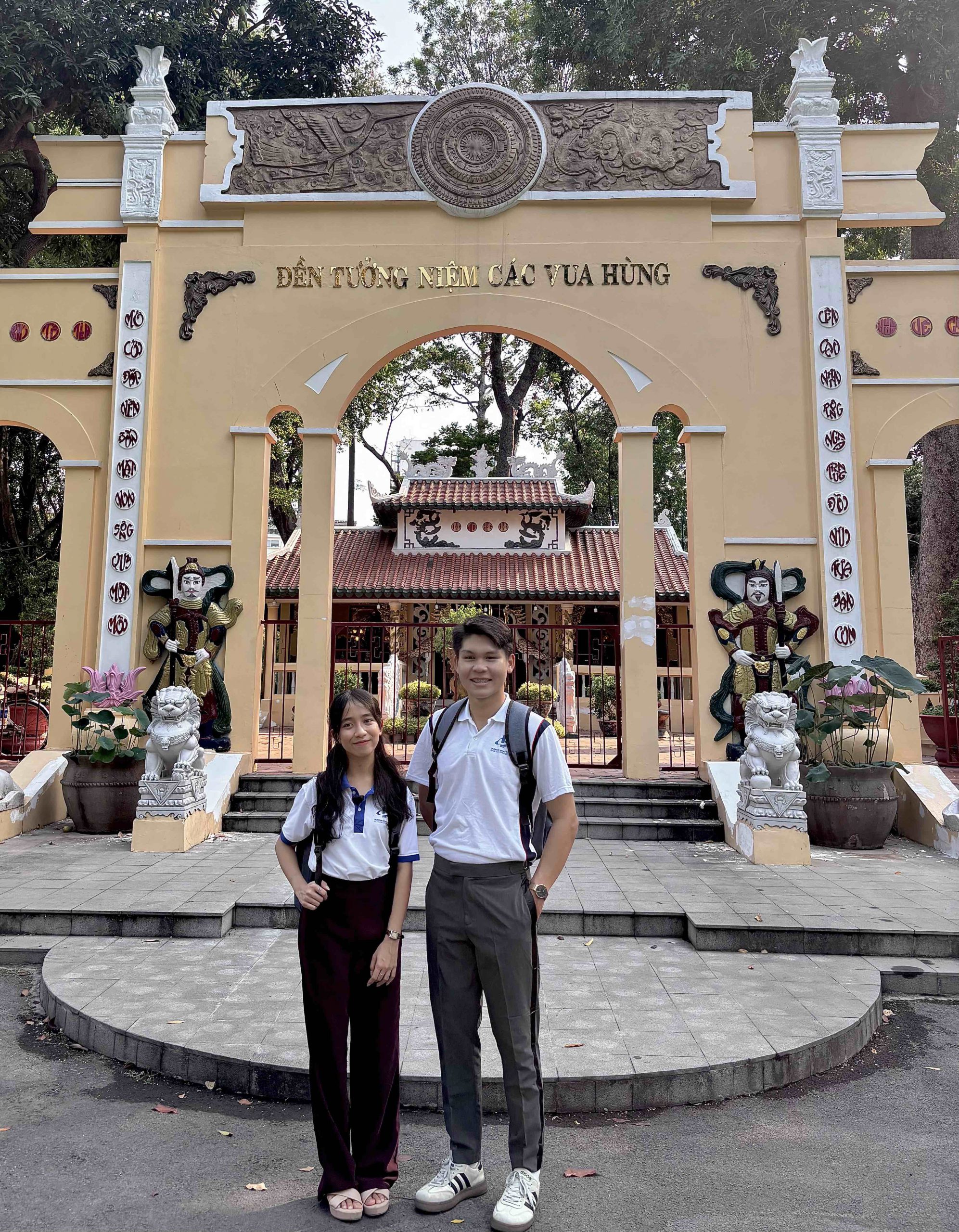
“Dù ai đi ngược về xuôi…” (Whoever go back and forth)
Every year, as the third lunar month arrives, Vietnamese people everywhere look back toward their ancestral roots with deep respect. The legend of our shared origin – “compatriots” has become an inseparable part of the national spirit passed down through generations. Vietnamese people always remind one another through a traditional folk verse:
“Whoever go back and forth,
Remember the Ancestors’ Day on the 10th of the third moon.
Throughout the land, the story is told and known,
Our nation’s spirit, for a thousand years, has grown.”
At HCMCOU, this spirit is spread through practical activities where international students live and experience the true pulse of local culture.
A miraculous similarity: A sociological perspective
On a sunny afternoon, Bình studies cultural symbols with Lint. On their table were documents about the Đông Sơn Bronze Drum, a treasure symbolizing the brilliant wet-rice civilization.
Lint shared with eyes sparkling with curiosity: “I am truly amazed by the intricate patterns on the drum’s surface. In Myanmar, we also have bronze drums called Karen drums. However, while our drums often emphasize simple natural symbols, Vietnam’s Bronze Drum is like a ‘chronicle’ cast in bronze. The star in the center representing the sun, the soaring birds, the scenes of people husking rice… it all feels like a miniature society coming to life.”
Lint’s surprise multiplied when Bình explained that this is a National Treasure – a particularly important tangible heritage of Vietnam.
Watch their journey exploring the meaningful values of the Hùng Kings’ Festival here: https://www.facebook.com/share/v/1c1nHijTe5/
Numbers that speak and pride in World Heritage
Instead of distant philosophies, Bình chose to share impressive, real-world figures with Lint. He emphasized the “Worship of the Hung Kings in Phú Thọ”, a tradition recognized by UNESCO as an Intangible Cultural Heritage of Humanity.
Bình excitedly shared: “Lint, did you know that there isn’t just one temple in Phú Thọ? Across the S-shaped land of Vietnam, there are nearly 1,500 sites dedicated to worshiping the Hung Kings. This number is a testament to how powerful the ancestral bond of the Vietnamese people is. No matter where we are, we find a way to establish a place of worship to remember our forefathers.”
A journey to “touch” history: A quiet moment in the heart of a busy city
What amazed Lint the most was when Bình led her to visit the Hung Kings’ Temple located within Tao Đàn Park, right next to the university campus. Stepping through the temple gates, a completely different space emerged—quiet and majestic, isolated from the hustle and bustle of Saigon’s streets.
Touching the intricate carvings and breathing in the scent of burning incense beneath the canopy of ancient trees, Lint said emotionally: “I used to think history was something very distant. I never expected such a sacred space to exist right next to where I study every day. Standing here, I no longer feel the noise of the traffic outside. It’s like an invisible thread connecting people to each other and to the past. Seeing how sincerely everyone offers incense, I understand why Vietnam is such a united nation.”
Culture without borders
The short journey of Lint and Bình has concluded, but it has opened a new perspective for young people. Under the roof of HCMCOU, students like Binh are daily contributing to the continued story of heritage through their professional knowledge and enthusiasm.
After all, despite the difference in languages, the gratitude for one’s roots always finds a common harmony.
Written by: Thao Anh